Luffa Mattress
77% less carbon than a standard dorm mattress — grown from a plant, designed for compost.


Class:
ENGS 171: Sustainable Product Design
OVERVIEW
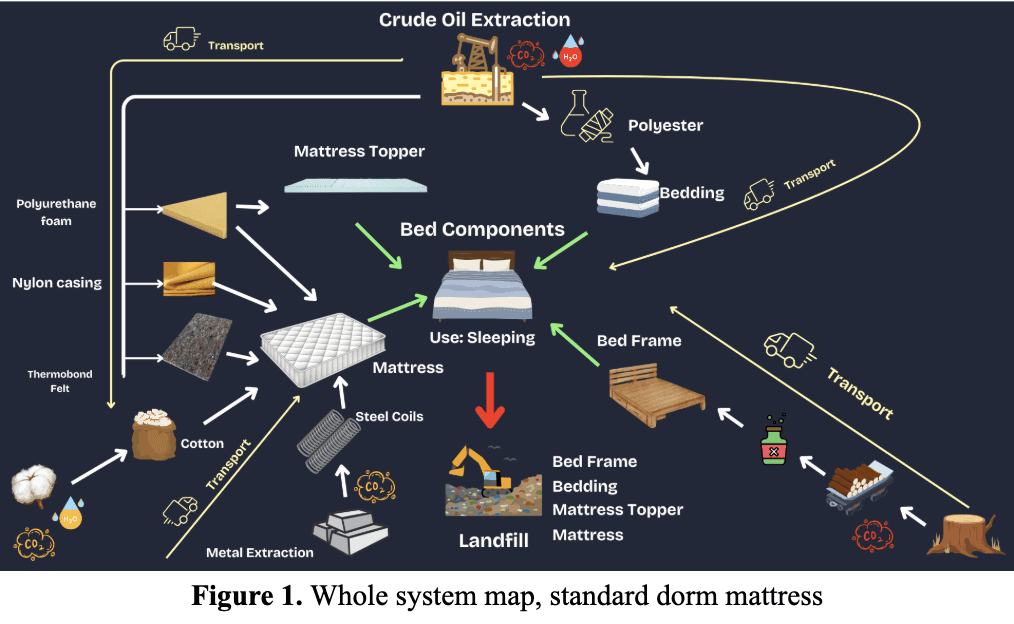
Redesigned the Dartmouth dorm mattress from scratch using luffa fiber, organic cotton, and methyl cellulose adhesive — replacing a crude oil-derived material system with a fully biodegradable one. A cradle-to-grave LCA comparing the redesign against the standard mattress found a 77% reduction in total CO₂eq emissions (292 kg → 67 kg per mattress), exceeding the original 25% reduction target by 3×.
The redesign also collapsed a global supply chain — components sourced from Germany, China, Thailand, and South Korea — into a fully domestic one, cutting transportation emissions by 92%.
MY ROLE.
Led whole-system mapping for both the standard and redesigned mattress, tracing material flows from raw material extraction through end-of-life to identify the highest-impact intervention points — analysis that identified the mattress (not the bed frame or bedding) as the component most in need of redesign
Drove prototype ideation and execution across two prototypes: flat-layered luffa (Prototype 1) and tubular luffa springs stuffed with organic cotton (Prototype 2)
Physically disassembled a standard dorm mattress to reverse-engineer its material system and inform the bill of materials for the LCA
–
Life Cycle Assessment (LCA) • Carbon Accounting • System Mapping • Iterative Prototyping • Sustainable Product Design
–
Life Cycle Assessment (LCA) • Carbon Accounting • System Mapping • Iterative Prototyping • Sustainable Product Design
–
Life Cycle Assessment (LCA) • Carbon Accounting • System Mapping • Iterative Prototyping • Sustainable Product Design
–
Life Cycle Assessment (LCA) • Carbon Accounting • System Mapping • Iterative Prototyping • Sustainable Product Design
–
Life Cycle Assessment (LCA) • Carbon Accounting • System Mapping • Iterative Prototyping • Sustainable Product Design
Related Projects